Galya
Grey BeesGalya is a shopkeeper who helps Sergey Sergeyich make a life after bringing his hives to Crimea. Her welcome begins in practical exchanges—help unloading the hives, food in return for honey, and meals delivered to his camp—but grows into a close relationship whose central question is whether Sergeyich will eventually bring his bees and live with her. Her story is told largely through his perspective: Galya acts and speaks for herself, while the narration also registers the hopes and limits he reads into her actions.
Identity and Introduction
Galya first enters Sergeyich’s life as the woman running the village shop. When he explains that he needs another person to unload his beehives and offers payment in honey, she considers the goods available in the shop and asks how much he would give her if she helped. Sergeyich offers three kilos and transport to and from the site. Her response makes the exchange more than a simple hiring arrangement: she suggests that he pay for honey with groceries, so he can feed himself, and offers him credit at the shop when he cannot take enough food at once to equal the honey’s value.
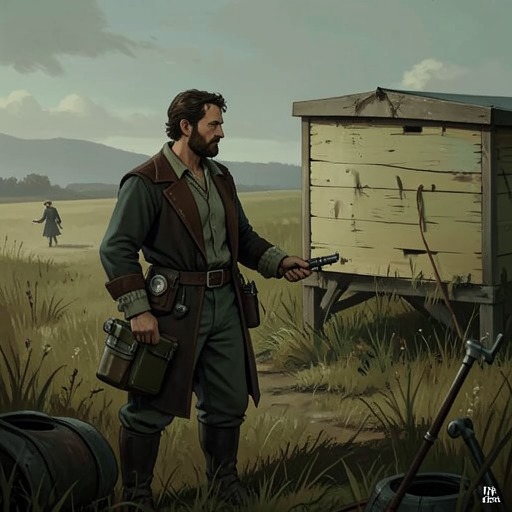
Their first work together gives Sergeyich a striking impression of her strength. She carries much of the weight as they move the hives from the trailer to a forest-side clearing about six kilometres down the road. They arrange six hives in two rows, with spaces between them so the bees have similar views of their surroundings. Sergeyich pays her the promised three kilos of honey in two one-litre jars, then offers more for sale. Galya proposes groceries in exchange, initially taking ten kilos. The arrangement meets a practical need for both: Sergeyich gets provisions and a way to establish himself, while the shop gains honey that its beekeeper usually takes to Odessa to sell.
Building a Household at the Campsite
The exchange gives Sergeyich more than an evening’s food. After returning to the shop, he eats bread and sausage and drinks artesian water; Galya has also extended him a line of credit worth 560 hryvnias, redeemable in groceries. The credit restores a sense of stability that he has largely lost through displacement. It makes the shop a dependable resource rather than a single transaction, and gives him a practical reason to return to the village.
Galya’s care takes a personal form when she brings meals to his camp on her scooter. After three dinners, including steamed turkey cutlets, she tells him that the borscht she had planned to bring cannot be delivered in acceptable condition. Sergeyich initially mistakes her explanation for an excuse not to visit. The scene instead shows how readily the visits have become part of his expectations: he is absorbed in her voice and in the prospect of another meal before understanding the reason she cannot bring it. Her food answers the shortages of his isolated camp, but the repeated visits also establish a routine of companionship.
The relationship develops alongside the honey trade without being reduced to it. Galya makes a commercial claim that Sergeyich’s honey is “anti-alcoholic,” and the sales pitch succeeds in neighbouring villages. As sales grow, she pays him in cash in advance rather than relying on the earlier shop credit. Yet the narrator makes clear that this change in payment does not turn their connection into a business relationship. Galya visits the campsite if she has not seen him for more than three days, though he usually goes to the village two or three times a week to fill his water canister, eat at her home, and buy provisions. Their contact remains warm and friendly, with a degree of independence that Sergeyich finds comfortable.
Intimacy and the Question of Home
Galya appears to respect the distance Sergeyich maintains between her house and his tent. He understands her as wanting closeness while avoiding the appearance of clinging to him, and he does not resist the emotional and physical intimacy they have developed. At the same time, he thinks of the camp and the hives as his own temporary home, and considers it inappropriate to stray from them for too long. The difference is consequential: he would accept more closeness, but is content with an arrangement that does not yet require him to move into her house.
The possibility of a shared home nevertheless surfaces. Sergeyich senses that Galya sometimes reveals, perhaps inadvertently, her wish for him to bring the bees to her orchard and live in her house. This is not merely an offer of shelter. The hives, his work, and his sense of belonging are bound together, so asking him to move the bees is also asking him to imagine a new home and a shared future. The offer remains a wish rather than an agreed plan; the narrative does not show him accepting it.
A later telephone call makes the emotional distance between them visible. While in Crimea, Sergeyich imagines his wife, Vitalina, and daughter, Angelica, among the vineyards, and then imagines Galya joining them, troubled rather than at ease. His mobile rings, and Galya is on the line. She asks where he is and tells him that Valik, the man whose eye had been stung by Sergeyich’s bee and who had smashed the Lada, has gone blind in the other eye. She advises Sergeyich not to come back just then. Her warning is an act of concern, but it also places their relationship at a distance: she is at home, while he is away with his bees, and their connection must pass through a call.
Loss, Invitation, and the Return Journey
Galya later tells Sergeyich that Valik has died by suicide, after becoming increasingly disoriented and getting into conflicts. She is clear that the death is awful, but her reason for calling is also to tell Sergeyich that he can return: no one will bother him now, and, she says, things will be better with him there. The death changes the circumstances of his possible return, but Galya’s invitation is not presented as a guarantee about what he will choose. It reopens a route to the life he left, and makes her own wish for his presence explicit.
On the journey home, the possibility of stopping with Galya returns to Sergeyich’s mind at the turn toward Vesele. Tired and sore, he thinks of her borscht and cosy home, and considers spending the night. He rejects that as the wrong understanding of her invitation: when they last spoke, she had invited him to stay with her, not merely to sleep over. He calls her, says he is already driving back, and tells her that he has put his friend’s daughter on the train and is heading home. Galya asks whether he will visit. His answer—that the Baptists are bringing coal for the winter, and will give it only to people who are there—defers the question rather than resolving it. The book leaves their future open: Galya has offered a home, but Sergeyich has not yet said whether he will make it his own.
Narrative Role
Galya’s importance lies in the practical and intimate forms her care takes. Credit, groceries, transport, honey, and meals are not incidental details; they make it possible for an uprooted beekeeper to eat, trade, and settle beside his hives. As Sergeyich’s honey moves from payment in kind to advance cash and wider sales, his material security grows in tandem with a relationship that remains personal rather than simply commercial.
Her presence also gives Sergeyich a possible future outside the isolated camp, without making that future effortless or certain. She offers the prospect of a house and orchard, while he remains attached to the bees and to the place he regards as his own. His thoughts turn to Galya at a literal fork in the road, but the turn toward Vesele does not settle the larger question. Through her, return becomes not just a journey back toward familiar territory, but a choice about whether to accept another person’s invitation to belong.